Professional Business Valuation Guide for 2026

What if the number you’ve spent a decade building your life around is off by 35%? According to the 2023 Exit Planning Institute State of Owner Readiness Report, 76% of business owners plan to transition their companies soon, yet few have secured a professional business valuation to anchor their expectations. You’ve poured your sweat and capital into your firm. It’s natural to feel protective of that legacy. Whether you’re navigating complex tax liens or preparing for a quiet sale, the confusion over technical financial jargon shouldn’t stand in your way. You don’t need aggressive tactics; you need a steady hand to navigate these murky financial waters.
This expert-led assessment unlocks the true market value of your company while serving as the essential foundation for a clean exit. We’ll show you how a defensible report eliminates the fear of undervalued assets and maximizes your final sale price. This guide breaks down the 2026 valuation landscape to move you from a state of urgency to a state of absolute clarity. We’ll ensure your transition is handled with the sophisticated expertise and discretion your life’s work deserves.
Key Takeaways
- Understand how a professional business valuation serves as the essential “North Star” for your 2026 exit strategy, ensuring you capture every dollar of earned equity.
- Learn why relying on a weighted average of core appraisal methodologies is the only way to avoid the confirmation bias common in generic online calculators.
- Identify the specific operational standards and financial transparency required to reduce owner dependency and transform your business into a high-value, turnkey acquisition.
- Explore how the Investahaus “Solution Pillars” bridge the gap between raw valuation data and a clean exit through sophisticated, creative financing structures.
The Role of Professional Business Valuation in Strategic Exit Planning
A business valuation serves as the bedrock of any successful divestment. A professional business valuation is the formal process of determining the objective economic value of your entire company or a specific business unit. It isn’t just a simple calculation of assets minus liabilities. It’s a deep dive into historical performance, future earnings potential, and market positioning. For business owners planning a retirement or a strategic sale in 2026, this assessment acts as your North Star. It provides a clear, data-backed baseline that guides every decision you’ll make over the next 24 months.
Understanding the distinction between Fair Market Value (FMV) and your “asking price” is vital. FMV is the price at which property would change hands between a willing buyer and a willing seller, neither being under any compulsion to buy or sell. Your asking price is often influenced by emotional attachment or personal financial goals. A certified valuation replaces these subjective feelings with market reality. This third-party assessment offers immense emotional relief. It transforms your life’s work from a collection of memories into a defensible financial asset, allowing you to enter the market with confidence rather than anxiety.
When is a Professional Valuation Non-Negotiable?
Certain triggers make a formal report mandatory. If you’re navigating a partnership buyout, estate planning, or preparing for a third-party acquisition, a “ballpark figure” won’t suffice. Entering a negotiation without a professional business valuation is a high-stakes gamble. You risk leaving 15% to 20% of your equity on the table by failing to justify your multiples. Beyond the sale price, these reports are critical for IRS tax reporting and ensuring legal compliance during the transfer of ownership. It protects you from future litigation and ensures a clean exit.
Valuation as a Diagnostic Tool for Growth
Shift your perspective from the end goal to the current process. Use the valuation as a diagnostic tool to identify “value leaks” in your operations. Perhaps your client concentration is too high, or your recurring revenue is too low. Knowing your value today allows for a 2-3 year polishing period. This is where the “Expert Strategist” approach pays off. You don’t just accept the current number; you use the data to fix inefficiencies and strengthen your market position. By the time 2026 arrives, you’ve systematically increased your multiples, ensuring you capture maximum liquidity at the closing table.
- Identify hidden operational risks before buyers find them.
- Benchmark your performance against industry peers.
- Create a roadmap for increasing transferable value.
- Establish a credible foundation for future price negotiations.
The Core Methodologies: How Professionals Determine Real-World Value
Determining what a company is worth requires more than a simple calculation. A professional business valuation provides the clarity needed for a clean exit by relying on three primary pillars: Asset-Based, Market-Based, and Income-Based approaches. Expert appraisers rarely rely on a single figure. They apply a weighted average across these methods to ensure the final number reflects current market realities and stands up to scrutiny during due diligence. This choice depends heavily on your specific industry and the stability of your cash flow. While a tech firm might be valued on aggressive growth projections, a manufacturing plant often leans on tangible assets. Rigor is the difference between a guess and a closing price. Professionals look past basic EBITDA multiples to analyze specific risk profiles and operational depth.
The Income Approach: Discounted Cash Flow (DCF) and Capitalization
The Income Approach views a business as an investment vehicle. The Discounted Cash Flow (DCF) method calculates the present value of all expected future earnings, adjusting for the time value of money to reflect what those dollars are worth today. For businesses with predictable, steady growth, the Capitalization of Earnings method offers a more streamlined view by dividing current earnings by a capitalization rate. EBITDA stands for Earnings Before Interest, Taxes, Depreciation, and Amortization, and it serves as the primary metric for determining the operational cash flow of a small-to-medium business. This approach is ideal for companies where the primary value lies in their ability to generate consistent profit rather than their physical inventory.
The Market Approach: Real-World Comparables
Appraisers use “comps” to see what similar businesses sold for within the last 12 to 24 months. This process involves analyzing transactional spreads to gauge current market sentiment and buyer appetite. Understanding how to calculate business valuation requires looking at private transaction data rather than public stock markets. Public market capitalization is often irrelevant for private small-to-medium enterprises because it fails to account for the “illiquidity discount” inherent in private sales. A professional business valuation adjusts for these differences, ensuring your price reflects what local or national buyers are actually paying for similar cash flows.
Asset-Based Valuation: Beyond the Balance Sheet
This method distinguishes between Liquidation Value, which assumes a quick sale of parts, and Going Concern Value, which assumes the business continues operating. Intangible assets like proprietary systems, customer lists, and brand reputation often hold more weight than physical equipment. Investahaus evaluates complex assets that traditional agents might overlook, ensuring every piece of intellectual property is counted. Whether you are dealing with specialized inventory or unique real estate holdings, a strategic exit consultant can identify hidden value that standard formulas miss. By reimagining the value of your equipment and proprietary data, you can often justify a higher asking price that reflects the true cost of rebuilding your success from scratch.
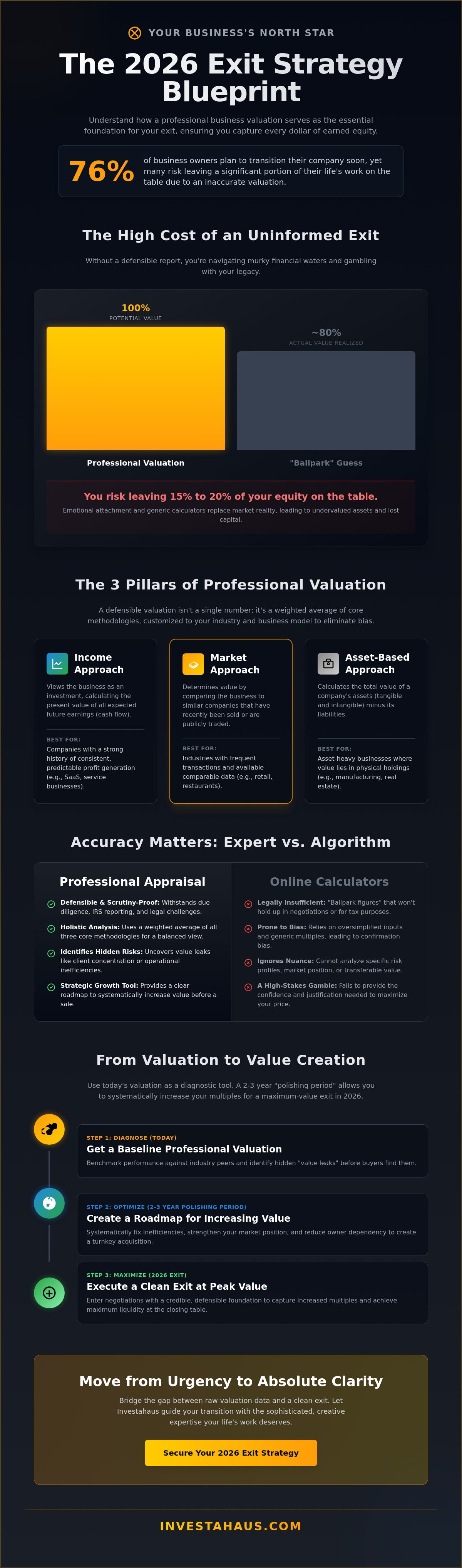
Professional Appraisal vs. Online Calculators: Why Accuracy Matters
You’ve seen the ads promising a business value in 60 seconds. These algorithms are tempting. They offer a quick ego boost. Relying on a generic calculator is a strategic error that often leads to failed deals. These tools ignore the nuances of your unique business context. They can’t account for the “Normalization” process where a professional adjuster removes a one-time $12,000 legal settlement or your personal $45,000 vehicle lease from the books. A professional business valuation ensures these expenses don’t artificially deflate your company’s worth.
Confirmation bias is a quiet deal-killer. Owners often test multiple calculators until they find the one that justifies their desired “magic number.” This creates a false sense of security. Sophisticated buyers don’t trust automated outputs. They arrive with teams of analysts ready to pick apart every line item. If your asking price is based on a web tool, your credibility vanishes during due diligence. You need a defense-grade report that stands up to intense scrutiny from private equity groups or high-net-worth individuals.
The Hidden Risks of Undervaluing Your Business
Selling too low is a silent tragedy. Without a professional benchmark, you might accept an offer that leaves 25% of your equity on the table. Accuracy allows you to command a premium during competitive bidding. Consider a common scenario: spending $50,000 on “polishing” operations, such as documenting SOPs or cleaning up aged receivables, can frequently trigger a $500,000 increase in the final valuation. This 10x return is only visible when you use a professional business valuation to identify which levers actually drive value in your industry.
- Avoid the “money left on the table” syndrome by identifying intangible assets.
- Justify a higher multiple by proving consistent cash flow through normalized earnings.
- Create a “bidding war” environment with a price backed by hard data rather than guesswork.
Standardization and Credibility (USPAP)
Trust isn’t granted; it’s earned through rigorous methodology. Professional appraisers follow the ASA Business Valuation Standards and USPAP (Uniform Standards of Professional Appraisal Practice) guidelines. These aren’t just suggestions. They’re the gold standard that bank lenders and SBA officials demand before approving an acquisition loan.
At Investahaus, we lean into this intellectual rigor. We provide the transparency needed for a clean exit, ensuring your numbers are bulletproof. Whether you’re dealing with a complex partnership buyout or a straightforward sale, our approach replaces “back-of-the-napkin” math with certified reports. This level of detail provides the peace of mind that your legacy is protected and your financial future is secure.
Preparing Your Company for a High-Value Valuation
Maximizing your exit price requires a fundamental shift in perspective. You’re no longer just an operator; you’re an asset manager polishing a vehicle for its next owner. A professional business valuation does more than calculate numbers. It exposes the structural integrity of your organization. To secure a premium multiple, you must de-risk the investment long before the first letter of intent arrives. Clean financials and autonomous operations aren’t just perks. They’re the core components of liquidity.
The Financial Cleanup Checklist
Transparency is the currency of trust in any high-level acquisition. Buyers look for reasons to discount your price, and messy books are the easiest target. You need 36 to 60 months of audit-quality financial statements. This timeline proves consistency and allows an appraiser to normalize your earnings effectively. Scrub the ledger. If you’ve been running personal travel or vehicle leases through the business, stop now. These “add-backs” are often contested during due diligence, so it’s cleaner to separate them early.
- Manage Accounts Receivable: Healthy liquidity is vital. If more than 12% of your invoices are over 90 days past due, it signals weak collections or problematic clients.
- Address Non-performing Notes: Debt instruments or assets that aren’t generating a return create friction on your balance sheet. Clear these out to present a lean, high-performing entity.
- Normalize EBITDA: Work with an expert to identify one-time expenses, such as a major roof repair or a specialized software implementation, that won’t recur for the next owner.
Building “Transferable Value”
A business that requires your constant presence is a job, not a transferable asset. Strategic buyers pay a premium for turnkey operations. If you’re the primary rainmaker or the only person who understands the core technology, your valuation will suffer. Data suggests that businesses with a strong, autonomous management team can command a 25% higher multiple than those with heavy owner dependency. You want to prove that the machine keeps humming when you’re off the clock.
Diversification is your second line of defense. High customer concentration is a major red flag for investors. If a single client represents more than 15% of your total revenue, the risk of that client leaving after the sale is too high for most buyers to stomach. Spread your risk across a broader base to stabilize your valuation. Finally, document your “niche” moat. Whether it’s proprietary software or a specialized local service model, ensure every process is documented in a formal SOP. This turns your “know-how” into a tangible, sellable asset.
Every intellectual property filing and employee handbook should be organized and accessible. This level of preparation shows a level of sophistication that reassures sophisticated buyers. When you’re ready to see what your hard work is truly worth, a professional business valuation provides the roadmap for your final exit strategy.
Need a strategic plan for your next move? Consult with an expert exit strategist to secure your clean exit.
Bridging the Gap: How Investahaus Turns Valuation into Execution
A number on a page is just the beginning. At Investahaus, we don’t just hand you a report; we build the bridge between where you are and where you need to be for a successful transition. Our strategy combines raw data with creative execution to ensure you maximize your lifetime of effort.